It's Not a Phase, Mom: The Very Real Science Behind Why Humans Are Absolutely Unhinged for Pandas
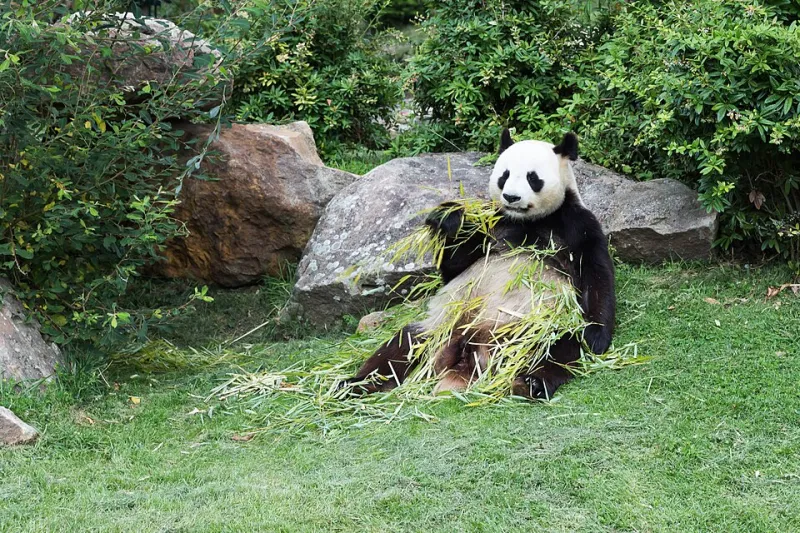
Photo: Another one of my pictures: This photograph was taken by Medium69 (William Crochot) and released under the license stated below. You are free to use it for any purpose as long as you credit the author (William Crochot), the Source (Wikimedia Com
Let's start with a confession: giant pandas, from a purely evolutionary standpoint, are kind of a mess. They're carnivores who decided to become herbivores. They eat a plant that provides almost no nutritional value and have to consume it for up to 16 hours a day just to survive. They're notoriously reluctant to mate in captivity, which has caused conservationists worldwide approximately one million collective headaches. They fall off things constantly. They sneeze dramatically and startle themselves.
And yet.
Yet, the moment a panda sneezes on camera, 40 million people watch the clip. Zoos that acquire pandas report immediate spikes in attendance. Panda cubs born in captivity become international celebrities before they've opened their eyes. Entire brands — including, full disclosure, the very website you're reading right now — are built around the cultural gravity of these black-and-white bears.
So what is going on? Why are we like this? Let's find out.
The Brain Chemistry of "Aww": It's Literally Neurological
There's a German word — Kindchenschema — coined by ethologist Konrad Lorenz in 1943, and it describes something researchers have been studying ever since. Translated roughly as "baby schema," it refers to a specific collection of physical features: large head relative to body size, big forward-facing eyes, round chubby cheeks, small nose and mouth, and soft, rounded body proportions. Lorenz proposed that humans are hardwired to find these features irresistible because they trigger our caregiving instincts — they're the same features that make human babies look cute so that adults don't, you know, abandon them.
Here's the kicker: giant pandas hit nearly every single point on this list.
Pandas have enormous, round heads. Their eyes are large and forward-facing (the dark patches around them actually make the eyes appear even bigger than they are). They're roly-poly and soft-looking. They move slowly and clumsily in a way that reads as endearing rather than threatening. Essentially, pandas are nature's accidental masterpiece of cuteness engineering — they didn't evolve to charm humans, but they stumbled into the perfect configuration to do exactly that.
When you see a panda, your brain releases a small hit of dopamine. You feel a pull toward the animal. You want to protect it, watch it, and possibly own seventeen items of merchandise featuring its face. This isn't weakness. This is your nervous system doing exactly what it's supposed to do. You are simply very, very normal.
The American Panda Relationship: A Brief and Delightful History
Americans have had a complicated, passionate, and occasionally politically loaded relationship with giant pandas for over a century. The first live panda to reach American soil was Su Lin, brought to Chicago's Brookfield Zoo in 1937, where she caused an immediate sensation and sold out the gift shop. (Sound familiar?)
But it was the era of "panda diplomacy" in the 1970s that really cemented the panda's place in American cultural consciousness. When China gifted Ling-Ling and Hsing-Hsing to the National Zoo in Washington, D.C. in 1972 following Nixon's historic visit, the event was covered like a moon landing. Thousands of people lined up to see the bears. The pandas became symbols of international goodwill, diplomatic thaw, and the universal language of being absolutely adorable.
Decades later, the National Zoo's panda program — and the live-streamed panda cams that came with it — became one of the earliest viral internet phenomena. People would watch pandas eat bamboo for hours. Nothing was happening. Everything was happening. It was perfect.
This history matters because it means Americans didn't just stumble into panda love — they were gradually, deliberately, and joyfully marinated in it across generations.
Social Media and the Infinite Panda Content Machine
If the 20th century gave Americans pandas through diplomacy and zoo visits, the 21st century delivered them directly into our eyeballs at 3 a.m. via TikTok.
Panda content is a social media phenomenon that shows absolutely no signs of cooling down. Accounts dedicated entirely to panda videos routinely rack up millions of followers. Clips from Chinese panda breeding centers — where cubs tumble over each other in slow motion while staff in panda suits attempt to wrangle them — go viral on a near-weekly basis. The formula is shockingly consistent: panda does something clumsy or cute, humans collectively short-circuit, engagement numbers go through the roof.
Why does panda content perform so well specifically? Researchers who study social media virality point to a few factors. First, panda videos are universally non-threatening — they don't require cultural context, they don't have a political angle, and they don't make anyone feel bad. In an internet landscape that often feels like a stress-inducing obstacle course, a 30-second clip of a baby panda rolling down a slide is genuinely restorative. It's a palate cleanser for the soul.
Second, pandas inspire what psychologists call positive affect — a measurable improvement in mood. Studies have shown that viewing cute animal images can reduce stress hormones, increase focus, and even improve fine motor performance. Watching panda content is not procrastination. It is self-care. You're welcome.
Conservation, Guilt, and the Power of a Good Mascot
There's another layer to the panda obsession that doesn't get talked about enough: the conservation angle adds genuine emotional weight to our affection. Pandas are an endangered species. There are fewer than 2,000 giant pandas left in the wild. That knowledge transforms our fondness into something more complex — part delight, part protectiveness, part low-grade existential anxiety about the state of the planet.
The World Wildlife Fund chose the giant panda as its logo back in 1961 for exactly this reason. The panda's cuteness makes people care. It puts a face on conservation that's impossible to look away from. You might not feel a visceral emotional response to a press release about habitat loss, but you absolutely feel something when you see a photograph of a panda cub.
This is what brands like Pudgy Pandas understand intuitively: the panda isn't just a cute image. It carries emotional resonance, cultural history, and a kind of wholesome optimism that feels genuinely rare right now. Leaning into panda culture isn't frivolous — it's tapping into something people genuinely need.
So What Does It All Mean?
At the end of the day, our collective panda obsession is a beautiful, neurologically sound, historically rich, and completely understandable response to an animal that is, objectively, one of the most visually compelling creatures on the planet. We love pandas because our brains are wired to love them. We love them because they carry decades of cultural meaning in the US. We love them because the internet delivers an endless supply of panda content specifically calibrated to make us feel better about everything.
And honestly? In a world that can feel pretty chaotic and overwhelming, there is something genuinely comforting about the fact that millions of people — across ages, backgrounds, and zip codes — can all agree that a panda rolling in snow is the best thing they've seen all week.
Welcome to the club. We've been expecting you. 🐼