Chunky Geniuses: How Pandas Are Accidentally Blowing Scientists' Minds One Bamboo Stalk at a Time
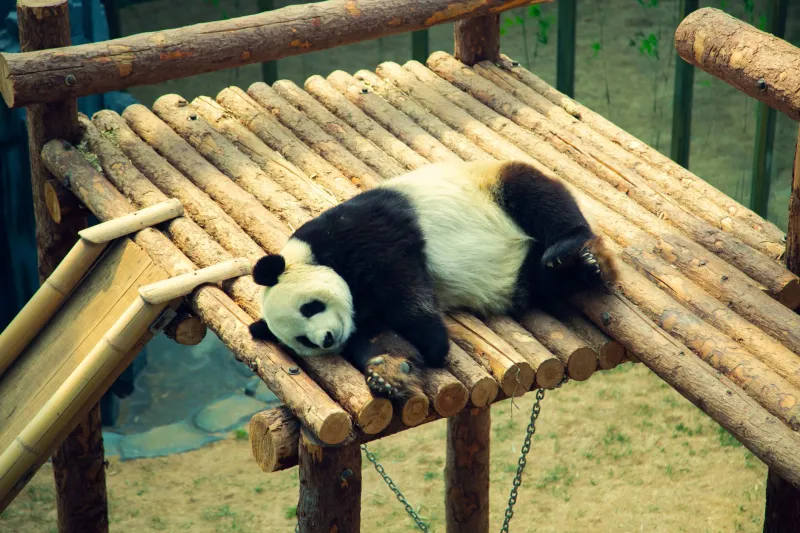
Let's be honest. When most of us think about giant pandas, we're not exactly picturing Nobel Prize ceremonies. We're picturing a 250-pound fluffball doing a slow-motion somersault off a play structure while a zookeeper quietly weeps in the background. We're picturing bamboo being devoured with the focused intensity of a college student stress-eating during finals week. We are not picturing groundbreaking contributions to animal science.
And yet. Here we are.
Because as it turns out, giant pandas — those wonderfully unhinged, perpetually confused, deeply round ambassadors of the animal kingdom — are quietly handing researchers some of the most fascinating biological puzzles ever encountered. Scientists are losing sleep over these bears. Good sleep. The excited kind. And honestly? Same.
The Digestive System That Should Not Work (But Absolutely Does)
Let's start with the most baffling thing about pandas, which is how they are even alive.
Giant pandas are, technically, carnivores. Their digestive systems are built for meat. Short gut, fast transit time, the whole carnivore package. And yet, they eat bamboo — almost exclusively — a food so low in nutritional value that most animals wouldn't bother. Bamboo is basically the rice cake of the plant world. It's fibrous, it's tough, and it offers so few calories per bite that pandas have to spend up to 16 hours a day eating just to stay functional.
By all biological logic, this should not work. Researchers at the Smithsonian's National Zoo and scientists across multiple institutions have spent years trying to figure out exactly how pandas extract enough energy from what is essentially crunchy cardboard. What they've found is genuinely wild: pandas have evolved a highly specialized gut microbiome — a community of bacteria in their digestive tract — that shifts seasonally depending on which part of the bamboo plant they're eating. In spring, when pandas chow down on tender bamboo shoots, the microbial community shifts to maximize nutrient extraction. In winter, when only tough stalks are available, the microbiome adjusts again.
This dynamic, season-responsive gut ecosystem is teaching researchers things about microbial flexibility that could eventually have implications for human gut health research. Yes, your panda obsession might one day indirectly contribute to better probiotics. You're welcome, humanity.
The Fake Thumb That's Actually a Masterclass in Evolution
Here's another thing that makes biologists absolutely feral with excitement: the panda's pseudo-thumb.
Pandas have a bony protrusion on their wrist — an enlarged radial sesamoid bone — that functions like a sixth finger, allowing them to grip bamboo stalks with surprising dexterity. It's not a real thumb. It's a repurposed wrist bone that evolution basically said eh, close enough and ran with. And it works remarkably well.
What makes this genuinely mind-bending is that it developed independently from the opposable thumbs found in primates. Studying the panda's pseudo-thumb has given evolutionary biologists a living case study in convergent evolution — the phenomenon where completely unrelated species develop similar solutions to the same problem. It's like the universe running the same experiment twice and getting two very different, equally weird results.
For researchers studying how complex traits evolve, the panda's chunky little wrist-thumb is basically a gold mine wearing a fur coat.
Social Lives More Complicated Than Anyone Expected
For decades, giant pandas were considered the introverts of the bear world — solitary, asocial, basically the animals most likely to decline a party invitation. And while it's true that pandas don't form long-term social bonds the way elephants or wolves do, recent research has complicated that narrative significantly.
Studies using GPS tracking and camera traps in China's Qinling and Minshan mountain ranges have revealed that wild pandas actually have surprisingly rich social networks. They communicate through scent markings on trees, leaving detailed chemical messages about their identity, reproductive status, and even mood. Researchers have documented pandas visiting each other's scent-marked trees regularly — essentially checking their messages like a very slow, very furry version of social media.
What's more, some pandas appear to have consistent social relationships with specific neighbors, revisiting the same individuals' territories over multiple years. This level of social complexity in a species previously written off as a loner is forcing behaviorists to rethink their assumptions about what constitutes a "social" animal. Turns out the panda was never antisocial. It was just using a communication system we weren't paying close enough attention to.
What Panda Reproduction Teaches Us About Reproductive Biology
Oh, panda reproduction. The topic that has launched a thousand anxious conversations among conservation staff and made panda breeding programs simultaneously the most stressful and most scientifically interesting work in the zoo world.
Female giant pandas are only fertile for 24 to 72 hours per year. That's it. One tiny window. And for years, getting captive pandas to successfully reproduce felt like trying to solve a puzzle with half the pieces missing. But the intense focus researchers have poured into understanding panda reproductive biology has yielded breakthroughs with applications far beyond pandas themselves.
Advances in hormone monitoring, artificial insemination techniques, and neonatal care developed through panda breeding programs have been adapted for use with other endangered species. The ultra-sensitive hormone tracking methods refined to detect that impossibly brief fertile window in female pandas? Those same techniques are now being used to improve breeding programs for other at-risk animals, from clouded leopards to African wild dogs.
Pandas, by being spectacularly inconvenient to breed, accidentally made scientists much better at breeding lots of other animals. Iconic behavior, honestly.
The Conservation Blueprint Nobody Planned For
Perhaps the most unexpected scientific contribution pandas have made is serving as a blueprint for large-scale habitat conservation. Because pandas require such vast, contiguous areas of bamboo forest to survive, protecting panda habitat means protecting enormous swaths of biodiversity-rich land in China's mountain ecosystems.
Researchers studying the downstream effects of panda conservation zones have found that these protected areas shelter hundreds of other species — from snow leopards to golden snub-nosed monkeys — that benefit from the same protections put in place for the pandas. The panda, somewhat accidentally, became what conservation biologists call an "umbrella species": one whose protection creates a wide shelter for an entire ecosystem.
This has fundamentally influenced how conservation organizations in the US and globally now think about species selection for protection programs. Instead of trying to save every threatened species individually — an impossible task — focusing resources on umbrella species that anchor entire ecosystems has become a guiding strategy. And that strategy has panda-shaped fingerprints all over it.
The Fluffiest Research Assistants in the Game
Look. Pandas did not ask to be scientific pioneers. They asked for bamboo, a good napping spot, and maybe a cardboard box to destroy. But in the process of simply existing in their magnificently impractical way, they've handed human researchers tools, insights, and frameworks that are genuinely advancing our understanding of biology, evolution, behavior, and conservation.
They are, in the most unintentional and deeply charming way possible, doing the work.
So the next time you're 45 minutes deep into a panda enrichment video at 2 a.m. — watching a very round bear attempt to climb a very small log and fail spectacularly — just know that you are, in a sense, appreciating one of nature's great accidental geniuses.
You're basically watching science happen.
And it is absolutely precious.